A patient sits comfortably and confidently, reflecting improved quality of life after spine and nerve care at UTMB Health.

Spine & Peripheral Nerve

Care that keeps you moving

Your spine is central to how you move, feel, and live your life. When problems like a slipped disc, pinched nerve, or spinal tumor appear, they can cause serious pain, weakness, or trouble with balance. At UTMB Health, our expert team is here to help you feel better and move with confidence again.

We care for a wide range of spine and nerve conditions, from everyday back pain to complex spinal cord disorders. Our surgeons use the latest tools and techniques, including minimally invasive procedures, spinal decompression, and spinal cord stimulation. Whether you need surgery or another type of care, we’ll work closely with you to find the right treatment and support your recovery every step of the way.

A provider points to spinal imaging to explain a diagnosis during a spine and peripheral nerve evaluation at UTMB Health.

  Conditions We Treat

A neurosurgeon explains spine imaging results to a patient during a consultation for back and neck pain at UTMB Health.

  Services & Procedures

We've highlighted some of the most common services—please explore the conditions list for treatments by condition.

Can’t find what you're looking for? Contact the care team at the clinic for assistance.

  Your Care Team Each provider may treat different conditions. Click on a profile to see their areas of specialty.

Neurosurgery

Neurology

 Frequently Asked Questions.

  • When should I see a neurosurgeon for back or neck pain?

    If your pain lasts more than a few weeks, keeps getting worse, or causes numbness, weakness, or trouble walking, a neurosurgeon may be able to help. At UTMB Health, our experts treat spine and nerve problems with both surgical and non-surgical options.
  • What is the difference between a herniated disc and a pinched nerve?

    A herniated disc happens when a spinal disc slips or tears. If it presses on a nearby nerve, it can cause a pinched nerve and lead to pain, numbness, or weakness. Our team can diagnose both and offer treatments to help you feel better.
  • How long does it take to recover from spine surgery?

    Recovery depends on the type of surgery. Many people feel better in a few weeks, while full recovery may take several months. Minimally invasive options can shorten healing time.
  • Are all spine conditions treated with surgery?

    No. Many spine and nerve problems can be managed with physical therapy, medications, or injections. Surgery is only recommended if other treatments haven’t worked or if the problem is serious.
  • What should I expect at my first visit and after surgery?

    At your first appointment, we’ll talk about your symptoms, review your health history, and may order imaging like an MRI or X-ray. Your neurosurgeon will explain your condition and walk you through your treatment options. If surgery is needed, we’ll let you know what kind of recovery to expect. Some procedures let you go home the same day, while others may require a short hospital stay. We’ll make sure you feel prepared every step of the way.
A specialist answers questions with an older adult during a spine and peripheral nerve consultation at UTMB Health.

  Our Locations

image of female UTMB Health patient wearing all black and standing by "Greetings from Kemah" sign

Deep Brain Stimulation changes life for woman with tremors

Reba Smith-Weeden’s hand shook so bad, she couldn’t drink a cup of coffee. She has a condition called essential tremor that prevented her from carving the Thanksgiving turkey one year at her Kemah home.

“I couldn’t do it,” she said.

Essential tremor is a neurological condition that is 10 times more frequent than Parkinson’s disease. It is an involuntary tremor that can happen as someone tries to do an everyday, normal movement, such as trying to pick up and hold a cup of coffee.

Smith-Weeden, 67, first noticed some shaking when she was in her 40s. At the time, she attributed it to being hungry or anxious. It got worse over 25 years. For the last four years, the shaking has been a major issue in her life.

“It was just a little bit of shaking in the beginning, but it slowly got worse,” Smith said. “I couldn’t do normal things.” close-up shot of female UTMB Health patient using tools including scissors and fine wire to make jewelry
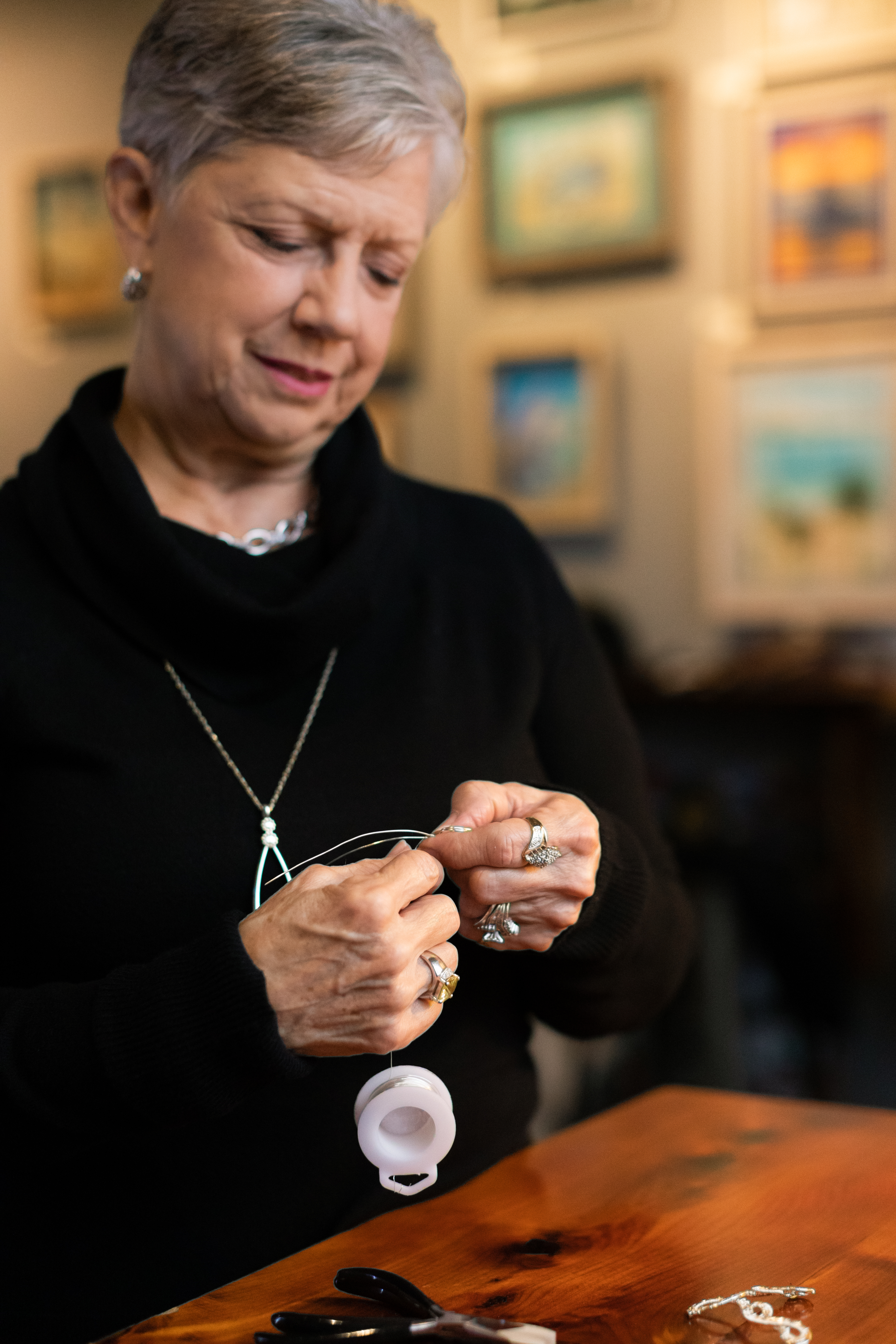
She couldn’t write her own name with her dominant hand. She learned to write it with her left, even though she still struggled with the shaking as she did it.

She used to make jewelry out of pieces of sea glass she collected in Mexico. She would wrap and weave wire around the sea glass to create jewelry. “I haven’t been able to do that,” she said.

Smith-Weeden started seeing a neurologist and tried a number of different medications. “Nothing seemed to work,” she said. “I was still shaking.”

A solution

Her doctor suggested she consider deep brain stimulation, often abbreviated DBS, a two-part operation that allows electrical stimulation to the brain.

Curious, Smith-Weeden began her research. She found a video online of a man who had the same type of surgery.

“He was still on the table, and they gave him a violin and he could play,” she said. “I was just like, wow! He wasn’t shaking. And he played it beautifully.”

A small mechanism turned the electrical stimulation on. She was convinced.

She met Dr. Patrick Karas, a neurosurgeon, who had just joined UTMB and performed deep brain stimulation.

“He made me feel at ease,” Smith-Weeden said. “He has a good bedside manner.”

The deep brain stimulation procedure involved two operations. The first surgery implants the electrodes in the brain. The second operation connects the electrodes to a pacemaker-type device in the chest.

Smith-Weeden had her first surgery in January and the second in February. Karas told her the device would be turned on one month after the initial surgery, but the shaking would stop immediately when the device is turned on.

The outcome

She remembers the day the shaking stopped. She had a follow-up appointment to test the device and how it was signaling her brain. The staff turned on the neurotransmitter.

Then her head stopped shaking and her voice tremors disappeared.

“They noticed it first before I did,” Smith-Weeden said. “I just cried. They programmed my neurotransmitter to tell my brain to stop shaking.”

They asked her to draw a spiral, and she did. She tried signing her name, and she could.

Now, she can put on her make-up. She can handcraft jewelry again. And she smiles a lot.

“I can drink my coffee without spilling it, I can eat without shaking, and I can brush my teeth.” Smith-Weeden said.

“This is life changing.”