An adult stands outdoors with eyes closed and a calm expression suggesting relief comfort and wellbeing.

General Neurology

Expert care for brain, nerve, and balance concerns

Neurological symptoms like headaches, migraines, dizziness, or fainting can be disruptive and concerning. The general neurology team at UTMB Health helps uncover the cause and guide you toward effective relief. Using advanced diagnostic tools and evidence-based treatments, our specialists focus on restoring comfort and confidence in your daily life.

Every patient’s experience is different, and so is their care. Your team will take time to understand your symptoms, listen to your goals, and design a plan that works for you. Whether you’re managing a new issue or a long-standing condition, you’ll receive attentive, personalized care from experts committed to helping you feel and function your best.

A neurologist listens closely while examining a patient during a focused medical consultation.

  Conditions We Treat

A patient lies still during a brain imaging scan while a healthcare professional monitors the procedure.

  Services & Procedures

We've highlighted some of the most common services—please explore the conditions list for treatments by condition.

Can’t find what you're looking for? Contact the care team at the clinic for assistance.

 Frequently Asked Questions.

  • When should I see a neurologist?

    You should consider seeing a neurologist if you experience frequent or unexplained headaches, memory changes, balance problems, numbness or tingling, seizures, or episodes of fainting. A referral from your primary care provider may be helpful.

  • What can I expect during my first neurology visit?

    During your first visit, the neurologist will review your medical history, ask detailed questions about your symptoms, and may perform a neurological exam. They may order tests such as an MRI, CT scan, or blood work to help make a diagnosis.

  • What’s the difference between a general neurologist and a specialist?

    General neurologists provide care for a broad range of neurological issues. If your condition is more complex, they may refer you to a subspecialist in areas like epilepsy, stroke, movement disorders, or multiple sclerosis for more focused care.

  • What causes dizziness or vertigo, and can it be treated?

    Vertigo and dizziness can be caused by inner ear problems, nerve issues, or changes in blood pressure. Your neurologist will work to find the cause and may recommend balance therapy, medications, or other treatments to help you feel more stable.

  • Will I need any tests after my visit?

    Possibly. Depending on your symptoms, the neurologist may recommend imaging tests (like an MRI or CT scan), blood work, or nerve conduction studies to help confirm a diagnosis and guide treatment.

A woman sits on a rocky trail with her dog during a hike showing balance confidence and an active lifestyle.

  Our Locations

image of female UTMB Health patient wearing all black and standing by "Greetings from Kemah" sign

Deep Brain Stimulation changes life for woman with tremors

Reba Smith-Weeden’s hand shook so bad, she couldn’t drink a cup of coffee. She has a condition called essential tremor that prevented her from carving the Thanksgiving turkey one year at her Kemah home.

“I couldn’t do it,” she said.

Essential tremor is a neurological condition that is 10 times more frequent than Parkinson’s disease. It is an involuntary tremor that can happen as someone tries to do an everyday, normal movement, such as trying to pick up and hold a cup of coffee.

Smith-Weeden, 67, first noticed some shaking when she was in her 40s. At the time, she attributed it to being hungry or anxious. It got worse over 25 years. For the last four years, the shaking has been a major issue in her life.

“It was just a little bit of shaking in the beginning, but it slowly got worse,” Smith said. “I couldn’t do normal things.” close-up shot of female UTMB Health patient using tools including scissors and fine wire to make jewelry
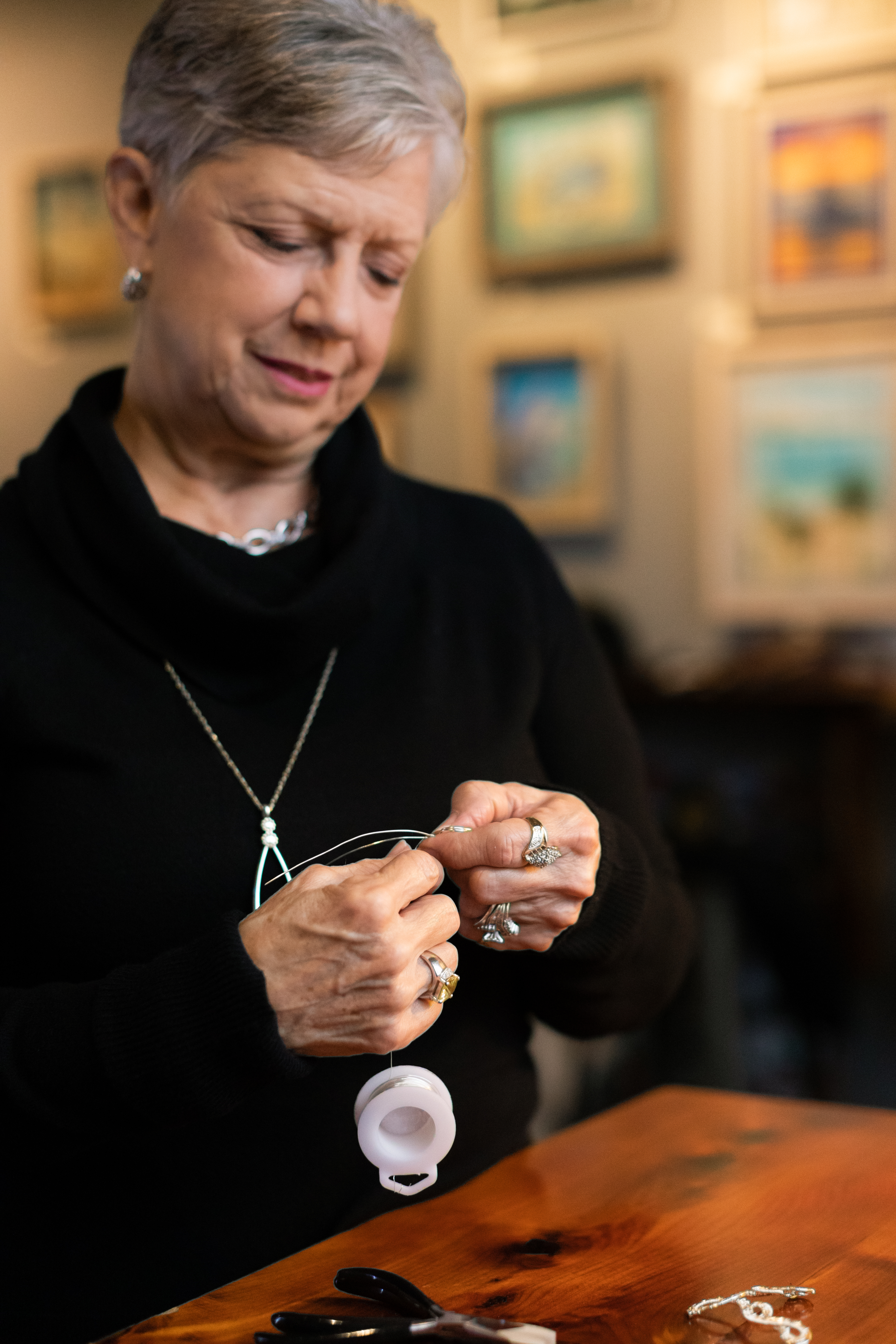
She couldn’t write her own name with her dominant hand. She learned to write it with her left, even though she still struggled with the shaking as she did it.

She used to make jewelry out of pieces of sea glass she collected in Mexico. She would wrap and weave wire around the sea glass to create jewelry. “I haven’t been able to do that,” she said.

Smith-Weeden started seeing a neurologist and tried a number of different medications. “Nothing seemed to work,” she said. “I was still shaking.”

A solution

Her doctor suggested she consider deep brain stimulation, often abbreviated DBS, a two-part operation that allows electrical stimulation to the brain.

Curious, Smith-Weeden began her research. She found a video online of a man who had the same type of surgery.

“He was still on the table, and they gave him a violin and he could play,” she said. “I was just like, wow! He wasn’t shaking. And he played it beautifully.”

A small mechanism turned the electrical stimulation on. She was convinced.

She met Dr. Patrick Karas, a neurosurgeon, who had just joined UTMB and performed deep brain stimulation.

“He made me feel at ease,” Smith-Weeden said. “He has a good bedside manner.”

The deep brain stimulation procedure involved two operations. The first surgery implants the electrodes in the brain. The second operation connects the electrodes to a pacemaker-type device in the chest.

Smith-Weeden had her first surgery in January and the second in February. Karas told her the device would be turned on one month after the initial surgery, but the shaking would stop immediately when the device is turned on.

The outcome

She remembers the day the shaking stopped. She had a follow-up appointment to test the device and how it was signaling her brain. The staff turned on the neurotransmitter.

Then her head stopped shaking and her voice tremors disappeared.

“They noticed it first before I did,” Smith-Weeden said. “I just cried. They programmed my neurotransmitter to tell my brain to stop shaking.”

They asked her to draw a spiral, and she did. She tried signing her name, and she could.

Now, she can put on her make-up. She can handcraft jewelry again. And she smiles a lot.

“I can drink my coffee without spilling it, I can eat without shaking, and I can brush my teeth.” Smith-Weeden said.

“This is life changing.”