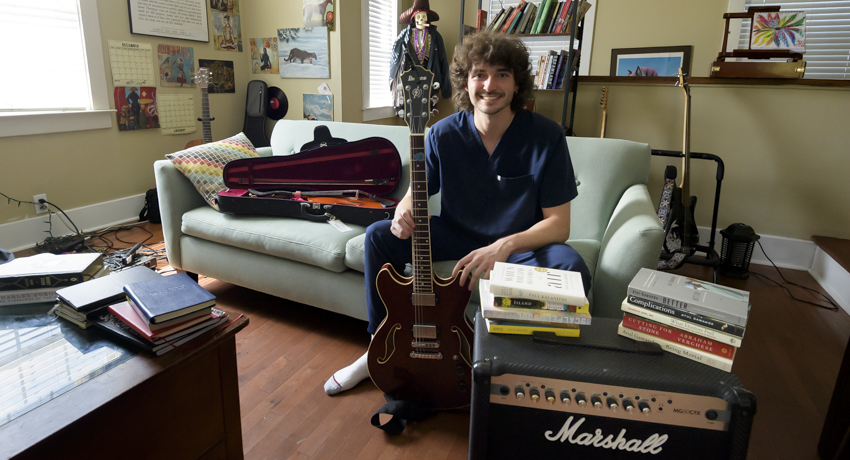
Aidan Carroll is an aspiring psychiatrist who wants to be a doctor of the soul.
The third-year medical student in the John Sealy School of Medicine at The University of Texas Medical Branch (UTMB) believes healing involves more than treating disease. To him, caring for patients means understanding their fears, relationships, purpose, mental health, and life experiences, not just their symptoms.
It’s a philosophy shaped by personal experience, family challenges, and a growing belief that medicine is as much an art as it is a science.
Finding purpose in medicine
Carroll's interest in medicine began early. As a child, he spent time observing his mother’s work as a veterinarian.
“She’d bring pets to my school for career day and show us preserved hearts that illustrated different diseases and conditions, and I thought it was super interesting,” he said. “The only classes I liked in high school were anatomy and physiology. I didn’t think about it too much. I always knew I would have a career in medicine. When I was in fifth grade, I’d say I wanted to be an anesthesiologist.”
Growing up in Allen, Texas, expectations were high. His mother was the daughter of Cuban immigrants, and his father was a successful engineer at a family-owned company. Both parents valued hard work and achievement, and Carroll said he internalized the expectation to excel in school and work harder than his peers.
As he worked through college, the pressure to perform began to take a toll. He struggled academically and believed his worth was measured by his grade point average. He lost sight of the purpose that had drawn him to medicine and began to wonder whether the future he imagined was slipping away.
“My family has a very traumatic story of escape from Cuba, and it really impacted everything in our lives,” he said.
“There’s so much psychological difficulty in my background,” he explained. “I’ve been in therapy since college, and my dad had serious struggles with mental illness. I don’t mind talking about it. Almost everyone has a history and a backstory with something like this. I think overcoming these trials is a big part of becoming who we are.”
Outside the classroom, Carroll found balance through music. He enjoys playing guitar, a creative outlet that helped him maintain perspective during difficult periods and reminded him that life extends beyond grades, test scores, and professional achievements.
A turning point came when his mother introduced him to books written by physicians.
Through those stories, Carroll began to see medicine as more than a career. He came to understand it as both a science and an art centered on caring for people.
“My mother gave me some books written by physician-authors that absolutely turned me around,” he said. “I first read ‘Complications’ by Atul Gawande, which changed my world, then ‘When Breath Becomes Air’ by Paul Kalanithi and ‘What Doctors Feel’ by Danielle Ofri, among several others. Those books were incredibly inspiring.”
“It’s beautiful,” he said. “Those books helped give my struggle in college meaning. Realizing that it’s an art form made me try harder, and after that, I wasn’t just studying for medical school. I was learning so I could know what to do when someone is sick and scared, and I can be there for them in a competent way.”
“Those books, and getting into therapy, helped me understand why I was doing this,” he said. “It’s not just to impress my family or to show everyone I’m smart. This is what it means to be a doctor who truly cares and genuinely wants to make the world better.”
With a renewed sense of purpose, Carroll's academic performance improved.
“I started taking more advanced classes, and the harder they got, the better I did,” he said. “I started performing incredibly well simply because I was passionate about the process. I stopped studying to impress a medical school admissions committee and started doing it because I genuinely wanted to become a good doctor.”
Caring for the whole person
As Carroll's perspective evolved, so did his definition of success.
Carroll said the experience reshaped not only why he wanted to become a physician, but also how he hoped to care for patients.
“Now, becoming a doctor so I can acquire things is pretty darn low on my list of priorities,” he said. “There’s a human being there. Once they leave the hospital, all that’s left is the relationship. I try to put myself in the shoes of being a patient.”
That mindset ultimately drew him toward psychiatry.
Professional mental health care had a meaningful impact on his own life, and family experiences deepened his understanding of the ways mental and physical health influence one another. As Carroll explored potential specialties, he became increasingly interested in approaches that consider the full range of factors affecting a person's well-being.
“The paradigm is shifting,” he said. “Now, there’s both therapy and medication. And I started doing independent research into spirituality, Eastern medicine, neuroscience, nutrition, and religion. I realized that all of it could help, and the best way for me to treat the whole person is through psychiatry.”
For Carroll, physical and mental health cannot be separated.
“It’s all connected,” he said.
Carroll came to see psychiatry as a specialty uniquely positioned to address the many factors that shape a person's health and well-being.
“I’m definitely going to be the kind of doctor who leads with the heart,” he said.
Whether caring for patients navigating mental illness, life transitions or other health challenges, Carroll hopes to bring both clinical expertise and compassion to every interaction.
His goal is simple: to care for the whole person.
“Every step on the journey is as important as the destination,” he said. “Being a psychiatrist is being a doctor of the soul.”